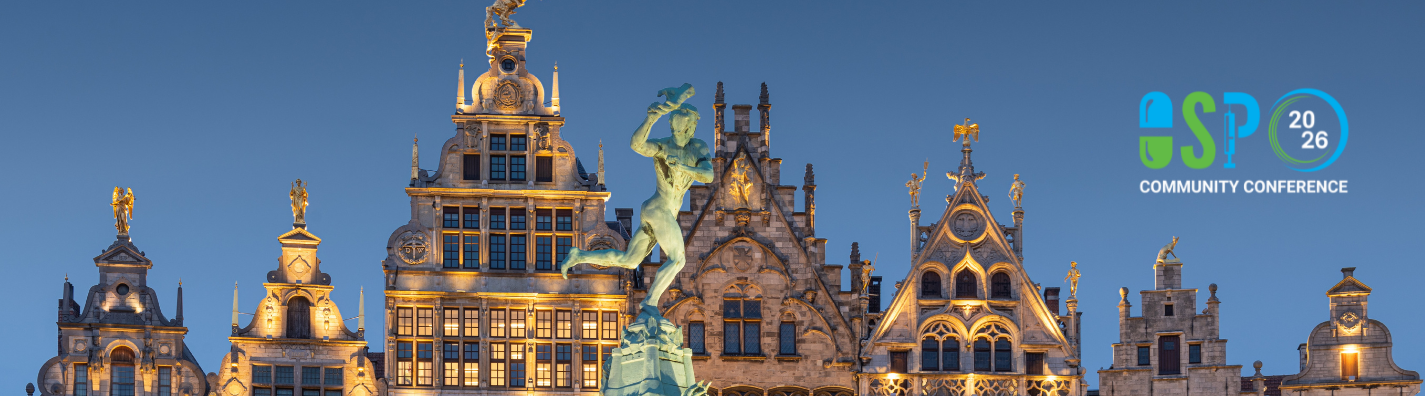
OSP Community Conference 2026
Join our next conference in Belgium
Welcome to the OSP Community Conference 2026!
Join us for two engaging in-person days at the Johnson & Johnson Campus in Beerse, Antwerp.
The event features five themed tracks covering topics from Clinical Applications to Regulatory Submissions. Whether you’re an experienced developer or just beginning your journey, there’s something here for everyone.
After the first day, join us for dinner at the Sky Venue by Corsendonk Hotels, a perfect opportunity to connect and network with fellow attendees.
Don’t miss this chance to learn, collaborate, and grow with like-minded professionals. This event brings together innovators, enthusiasts, and experts from the open-source community for inspiring talks, hands-on workshops, and meaningful networking.
We also invite our community to contribute — register NOW!
We look forward to welcoming you.
Contact us: info@clsfondation.org
WORKSHOP & POSTER INFORMATION

Workshop Venue Information
Workshops 1–4
The following workshops will take place at WIMEC, located at:
Everdongenlaan 29, 2300 Turnhout, Belgium
The venue is approximately a 15-minute drive from the Johnson & Johnson campus area. Please check your assigned workshop and room carefully:
| Workshop | Room |
|---|---|
| 1. Introduction to PBPK for IV and Oral Routes with PK-Sim | Room Magritte |
| 2. PK-Sim and R for PBBM and vBE | Room Mondriaan |
| 3. PK-Sim for DDI | Room Delvoye |
| 4. Introduction to MoBi | Room Dalí |
Transportation
Please note that the OSP Foundation will not provide transportation to WIMEC in the morning. Participants are responsible for arranging their own transportation to the workshop venue. However, at 11:30 AM, a bus will be waiting at WIMEC to transport all workshop attendees and instructors to the Johnson & Johnson campus.
Workshop 5: PK-Sim, MoBi, and OSP-R for Pregnancy
This is the only workshop to be held at the conference venue, the Johnson & Johnson (JJ) Campus.
Location:
Building 102, Room 210
⚠️ Important: Please wait at the reception upon arrival. A Johnson & Johnson representative will meet the group there and guide you to the workshop room.
Please make sure you arrive at the correct venue for your workshop and allow enough time for your journey.
We look forward to welcoming you to the workshops!

Recommendations for Poster Presenters
Posters should be prepared in portrait orientation using the A0 format (84 cm × 119 cm).
Please note that the following are suggestions to guide effective poster design; the only mandatory requirement is that the poster be prepared in A0 format. The printing of the poster is the responsibility of the presenter.
The title, authors, and affiliations should be displayed in a font of at least 72 points, and lowercase lettering is preferred over all capitals. Body text must be set at a minimum of 16 points to remain legible from a distance of one to two meters. A single, clear typeface such as Arial or Times New Roman should be used consistently throughout; stylized or handwritten fonts must be avoided. Text should be double-spaced, justified, and kept concise, with key points emphasized through color. Subtitles should be assigned a distinct color to separate them from the main text.
All figures must include a brief caption or legend, and arrows, labels, or callouts should be used to direct attention to critical elements. The same typeface should appear in both text blocks and graphics. Bar graphs and histograms are appropriate for comparing two groups, line graphs for showing trends over time, and pie charts for displaying proportions. Horizontal formats are preferred over vertical ones, with thin lines, clearly labeled axes including units, and an explanation of all symbols used. Images must be high in resolution and adequate in contrast, free of copyrighted material, and may be used to illustrate the study location or the tools employed.
Content should be arranged from the top-left toward the bottom-right, following the natural reading order. With the exception of the title, sections should be clearly distinguished through numbering, lines, bars, or spacing. Visual elements such as graphs, charts, images, and tables should occupy approximately half of the poster, as they capture attention and convey information efficiently.